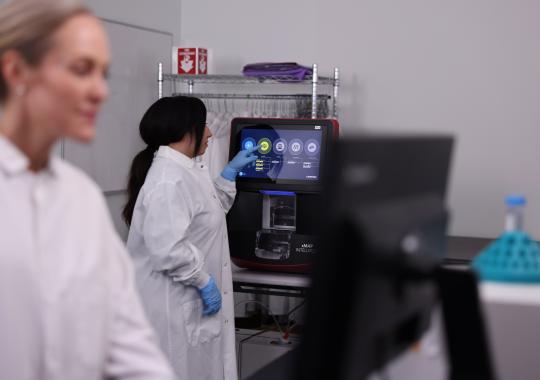
Researchers around the world are using xMAP® Technology to develop and evaluate new therapeutic candidates for this deadly cancer
Many people believe that a diagnosis of pancreatic cancer is effectively a death sentence. With five-year survival rates for the most advanced stage at just 13.7%, it’s not hard to see why. But recent studies are beginning to change that narrative. In the past year, clinical trials for several new therapies have demonstrated promising results, including extended survival for patients with advanced pancreatic cancer.
At this year’s annual meeting of the American Society of Clinical Oncology, researchers reported data from a phase 3 trial of daraxonrasib, a precision therapy from Revolution Medicines targeting RAS-activated pancreatic cancers. The results were so notable, they were met with a standing ovation.
The trial included 500 participants, with 248 participants receiving the new therapy while the remainders received standard-of-care. Median overall survival for patients taking daraxonrasib was nearly double that of the patients undergoing regular chemotherapy (13.2 months compared to 6.7 months). The drug also demonstrated a favorable safety profile, with few adverse side effects reported.
Trial breakthroughs furthering pancreatic cancer treatment plans
Additional progress came from a recent phase 2 study of elraglusib, an inhibitor of GSK-3β under development by Actuate Therapeutics, for patients with metastatic pancreatic ductal adenocarcinoma. In a study published in Nature Medicine (2026), researchers described results from treating 155 patients with elraglusib, compared to 78 patients getting standard-of-care treatment. At the trial data cutoff, patients taking the new therapy lived nearly 3 months longer than their standard-of-care counterparts (median overall survival of 10.1 months compared to 7.2 months). One-year survival rates were 44% for elraglusib patients and 22% for those on conventional treatment; results that led to planning for a phase 3 clinical trial.
mRNA-based therapies are also showing encouraging results. In a small phase 1 clinical study of a personalized mRNA cancer vaccine developed by BioNTech, 16 patients were treated, with half of them developing vaccine-induced T cells.
In this study published in Nature (2025), scientists reported that responders had prolonged survival without disease recurrence. Seven of the eight responders were still alive at least four years after treatment, compared to two of eight non-responders.
How xMAP® Technology supports therapeutic development
Many of these new drug candidates were developed or tested in part with Luminex xMAP® Technology. Daraxonrasib, for example, was originally tested in more than 800 cell lines using the Luminex xMAP to recognize barcode sequences in certain cell lines as part of the screening process.
In the elraglusib trial, researchers used a Luminex multiplex immunoassay to measure 40 cytokines, chemokines, soluble cell receptors, and growth factors from plasma samples. This analysis identified a subset of seven components that correlated with improved survival rates. xMAP Technology has also been imperative in the development of various mRNA vaccines and therapies.
With pancreatic cancer incidence on the rise, particularly amongst young adults, scientists conducted a study on the risk relationship between the disease and alcohol consumption (IJADR, 2026). In this study, it was found that even moderate drinking—consuming about two alcoholic drinks per day—was associated with a 10-30% increased risk of developing pancreatic cancer. Such findings demonstrate the need to expand patient treatment options.
As scientists discover new opportunities to make a difference in outcomes for patients with pancreatic cancer, xMAP Technology will support this progress by providing clear, therapeutically relevant biomarker data. Learn more about how you can use xMAP Technology inn therapeutic development at our website.
For Research Use Only. Not for use in diagnostic procedures.