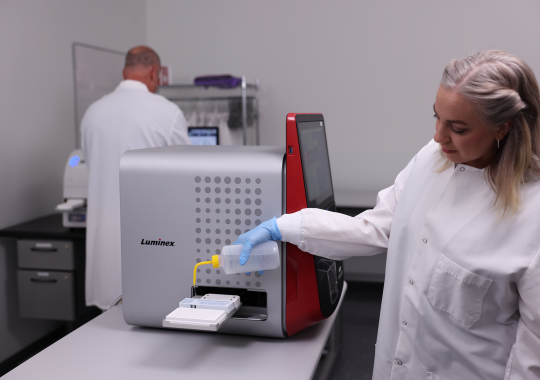
New JoVE video shows how to monitor immune response associated with COVID-19.
Early in the COVID-19 pandemic, researchers at Rush University Medical Center in Chicago developed and validated a multiplex serological assay to test for antibodies targeting four different antigens of the SARS-CoV-2 virus. The assay was based on xMAP® Technology and can track exposure to the virus based on antibodies targeting its spike, nucleocapsid, membrane, or envelope proteins.
Now, the same team has created a helpful video tutorial for anyone interested in monitoring the immune response to a COVID-19 vaccine or SARS-CoV-2 infection. The team’s method demonstrates how to measure dynamic antibody titer changes in IgA, IgM, or IgG. A multiplex reader with dual-reporter capacity, such as the xMAP INTELLIFLEX®, allows users to check two of the three immunoglobulins at one time.
Published by the online video journal JoVE, the step-by-step protocol comes from lead authors Cristina Fhied, Imad Tarhoni, and senior author Jeffrey Borgia. “This approach allows us to evaluate multiple epitopes on the same analyte,” Borgia explains in the video.
In the demonstration, Tarhoni performs and describes each step in the workflow. He shows how different time frames can be tested — he used increments of 30, 60, and 120 minutes — to compare results and determine which is best suited to achieve the desired results.
“This method has important implications for monitoring response to vaccines in immunocompromised individuals,” Borgia concludes. “It will permit us to determine if these patients are truly getting protected by these vaccinations.”
To learn more about the dual-reporter capabilities of our new xMAP INTELLIFLEX® System, check out this overview.
For Research Use Only. Not for use in diagnostic procedures.