Scientists are using xMAP® Technology to develop a new assay for vascular brain injury
Attendees of our latest xMAP® Connect event learned about the impact of multiplex testing for patients with vascular brain injury from Jason Hinman: Associate Professor at the University of California, Los Angeles and President of Sage Cerebrovascular Diagnostics.
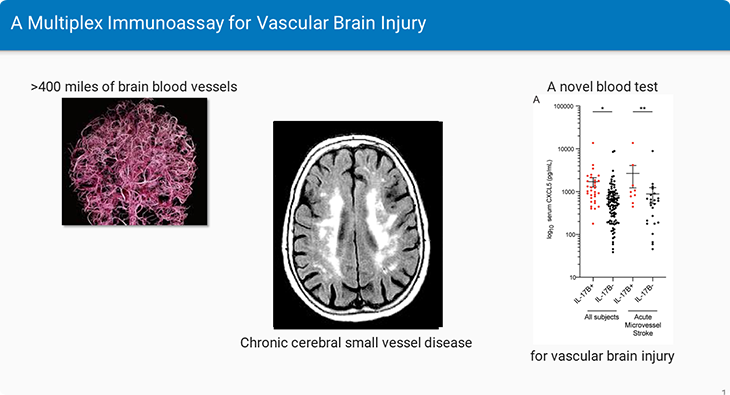
Dr. Hinman and his team developed a new assay for vascular brain injury using xMAP® Technology, making it possible to detect early risk of stroke with a multiplex immunoassay.
Detecting Early Risk of Stroke with a Multiplex Immunoassay
Hinman and his team aimed to develop a blood-based test able to detect key indicators of vascular brain injuries that increase the risk of stroke and dementia. Stroke, for instance, is a leading cause of disability and death around the world, Hinman noted. A more effective test to detect “silent” brain injuries would make it possible to improve treatment for those most in need.
At the beginning of this effort, Hinman was already acquainted with xMAP Technology, which he had previously used to measure cytokine activity associated with inflammatory signaling in the brain. His familiarity with xMAP Technology inspired him to continue utilizing the bead-based platform for his novel cerebrovascular test, which would aim to diagnose the presence of severe, silent brain injuries. The new assay, which was evaluated on patients at the Ronald Reagan UCLA Medical Center Emergency Room included six biomarkers and generated a composite score of 94% specificity using blood or serum samples.
“The Luminex xMAP Technology is really optimal for the challenge we are facing because it allows us to build a multiplex assay now that we can continue to augment in the future and it allows us to quickly scale,” Hinman explained.
Minimizing Cross-Reactivity in the Cerebrovascular Test
In his presentation, Hinman also spoke about the challenges of assay development and commercialization. His team worked with Luminex partner, Bio-Techne, to obtain robust antibodies for their desired targets. They also spent quite a bit of time minimizing cross-reactivity, ensuring strong performance across Luminex devices, and optimizing additional assay details.
Now, the assay will be tested in NIH-funded studies of up to 14,000 patients. Hinman’s team plans to launch it initially as a laboratory-developed test.
Watch the Presentation Now On-Demand
Watch the on-demand presentation now by visiting our xMAP Connect Virtual Conference Hub. While you’re there, be sure to check out more presentations from the xMAP Connect event in La Jolla to learn more about the latest advancements in multiplexing technology.
We hope to see you at the next xMAP® Connect event in Atlanta, GA this November to learn about the latest advancements in multiplexing technology.